Whatever sat in the shadows near the guardhouse hadn’t moved and continued to stare.
He kept the knife moving and his eyes off it. The light from the lanterns stopped short of the guardhouse. The little building’s corner blocked the light and created a pocket of shadows. Tall bushes crowded and darkened that corner. The scent of night jasmine came off the wall in the cool air, and under the jasmine, faint, the bathhouse mineral smell.
Off past the gate, a man laughed once in the street, and his boots carried the sound away toward the river.
The eyes had not closed the whole time.
Salt set the driftwood on his knee.
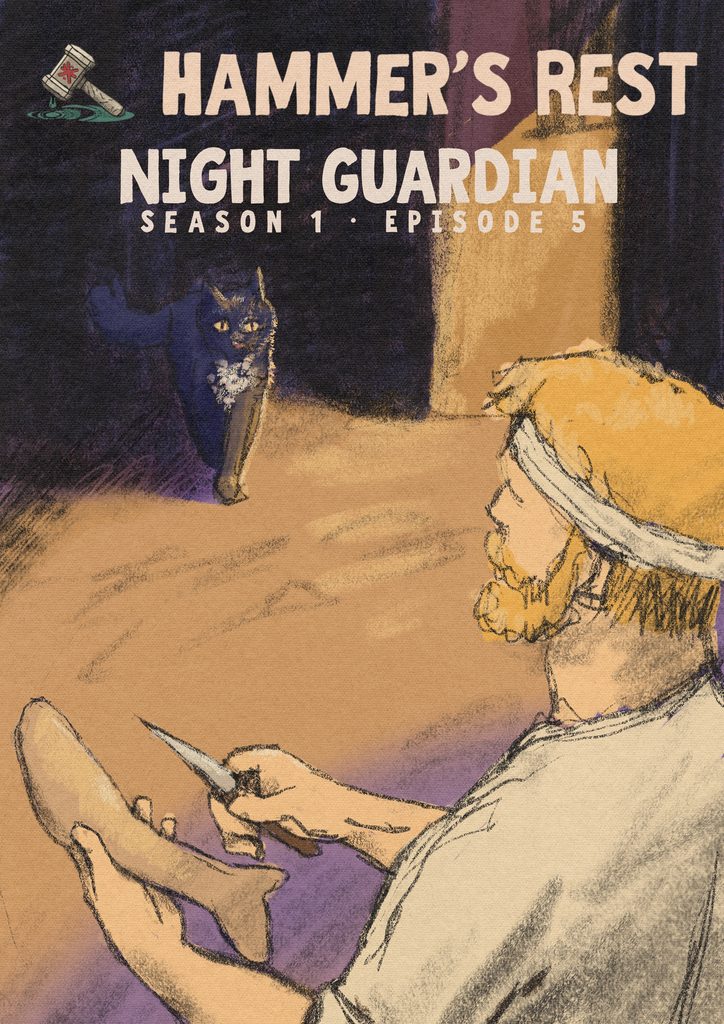
Then the darkness reorganized itself. The shape had not been there and then was, coming across the earth without sound, each paw set down before the next came up. A cat. Indigo fur so deep it drank the lantern light. White markings scattered down the chest, like light through leaves. The ears stood high and angled forward.
It stopped six feet from his chair, sat, and curled its tail over its paws.
Salt looked at it. It looked at Salt. Water kept falling into the fountain.
He went back to the driftwood. His hands wanted something to do, and the cat could make of that what it liked.
Shavings dropped onto the stone by his boot, pale against the dark. Dry, and no smell to them. The sea had taken that out of the wood long before he packed it. Last night the wood had given him one curve and nothing else. Earlier this evening it had gone wide at the bottom and split in two, which might be a tail and might be a mistake he had made without meaning to. Since he sat down after that, he had been putting scales above it, a run of them up the flank, each no bigger than a thumbnail.
The cat’s head tilted.
“Hello,” Salt said.
The tail moved once.
“Suit yourself.”
Its ears swung toward the street beyond the wall, held for a moment, and came back. Whatever had gone by out there did not warrant getting up for.
It stood, walked a slow half-circle toward the fountain, and sat again. Four feet.
Salt kept the knife going and watched sidelong, an old habit off a crowded deck. Up close, the animal was bigger than the shape in the dark had promised. Sitting, its head cleared his knee by a hand. Lean muscle lay close over the bone. The white on its front lay thicker than the indigo. The cat’s eyes were almond-shaped with vertical pupils that narrowed in the lantern light, framed by irises that glowed pale amber.
“What are you after?” Salt said.
The cat looked at him for a while. Then, at the carving.
He turned the piece so the scaled flank caught the light and held it out. “Not finished.”
It leaned forward from the shoulders, head only, and went over the wood inch by inch.
Then it stood, came past his chair close enough that its side dragged along Salt’s shin, and sat down behind him, facing the gate.
Salt did not turn around. He took in the gate, then the piece in his hands. Above the walls, the sky had cleared and three stars appeared while his head was down.
He kept carving.
“What is that supposed to be?”
The voice came from behind his left shoulder, low and exact. The knife went off the wood.
He turned. The cat sat where it had been sitting and blinked.
He put the knife back to the wood.
“Still deciding.”
“Two nights on the same piece of wood.” It came around in front of him and sat. “Eraphis.”
“Some things take longer,” Salt said. “Lyndon Blackwood. Most call me Salt.”
“Two nights, and you have a tail.” Eraphis looked at the wood with no respect. “At this pace the house will have changed hands before that thing has a face.”
Salt turned the piece over. He could not think of one useful thing to say to a talking cat who had just insulted his carving.
“The shoulder,” Eraphis said.
“It’s fine.”
“You lift with the arm and never the shoulder.”
Salt turned the wood over. “Three days, then.”
“I watch everyone who comes through those doors.” He licked his paw. “Not everyone stays.”
Somewhere past the wall a night bird made its complaint.
“That one roosts on the bathhouse chimney,” Eraphis said. “Every night. It has a nest three streets over in a wonderful tree. I gave up on the question years ago.”
“What happens to the ones who don’t stay?”
“They leave,” Eraphis said. “It’s the reliable part.”
“You out here every night for that?”
“Every night there is.”
“I stood watch.” Salt worked the knife along the grain, finding where a scale wanted to sit. “Middle of the night, mostly. You learn the sound a ship makes when nothing’s wrong, and after that you’re only listening for the other thing.” He took off a curl of wood. “Nobody thanks you for it. They wake up and the ship’s still there and that’s the whole of the thanks.”
The cat walked a short bit away and stared into one of the dark corners. “Yes,” Eraphis said.
“How long have you been doing it?”
“Longer than the wall.”
Salt looked up at that. The wall was ten feet of dwarf-cut stone and looked like it had been there since the town had a name.
“You keep count?”
“I don’t need to. Your pack is still by the door.”
The knife stopped. It was. Upright against the doorframe, straps done up, where his hand would find it in the dark.
“That’s not a question either.”
“No,” Eraphis said.
Salt let the rest of it go and looked at the wall instead, at the black stretch under the vine.
“You went into the water today,” Eraphis said.
Salt turned the carving over in his palm.
Eraphis’s tail settled once across the paws and stopped moving.
“Does everyone feel it?” Salt said. “The springs.”
“Those who need to. The rest find it pleasant and decide that’s the whole of it.”
“And the ones who need to?”
“Are holding too much.” The amber in his eyes shifted. “You were holding a great deal.”
Salt rolled the bad shoulder. It went further than it had that morning.
Eraphis’s tail twitched and stilled. “The rest doesn’t come loose in one sitting. Whatever Durnar told you, he was being kind.”
“He listened and explained that my muscles were tense.”
“With his hands, yes.” Eraphis bent his head and ran his tongue over one paw twice. Then he faced the tavern.
Salt smiled at the driftwood and had the smile off his face before he raised it.
The cat’s attention had gone off the tavern and back to Salt and onto the silver chain at Salt’s throat.
Everything about Eraphis stopped. The amber pulled in toward the center of each eye. For a moment he was some other thing wearing a cat.
Salt’s hand came up to it and had it out over the collar. Inside, the water sat level and dead calm, the way water never sits.
“Where did you get that?”
“Don’t know,” Salt said.
He waited for the rest of the questions. It didn’t come. Eraphis gave the globe a moment more, then brought his eyes up to Salt’s face and left them there.
“No,” Eraphis said. “You don’t.”
He stood, moved a few feet off, and sat down close to where the lantern light gave out. The white of his chest stood bright against all that darkness.
“What are you?”
The tail stopped moving.
“A cat,” Eraphis said.
“Durnar’s Spiritborn. There was a girl before him, years back, sea-fathered, and she had the same thing behind the eyes you and Durnar have got.” Salt set the knife down.
“Then you have your answer, and you’re asking anyway.”
“I’m asking because you didn’t say it first.” Salt’s palm lay flat and empty on his knee. “A man who knows what he is says so in the first minute. Saves time.”
For a while, the only sound was the water going over the fountain lip.
“Spiritborn,” Eraphis said. “That is what I am told and what I tell people.”
“That’s not the same as knowing.”
“No.” The ears went flat and came back up. “It is not.”
Then he bent his head and washed the same paw he had washed before, twice, and did not look at Salt while he did it.
“You came out of the water different.”
Salt got the globe back down inside his collar and ran his thumb along the grain instead, over the scales, down to the split shape at the bottom that had no name yet. “You keep saying things to me.”
“I don’t ask questions I already know.”
“Then what do you ask?”
The pause went on until Salt looked up. Both colors in those eyes, level on his face.
“The carving,” Eraphis said. “Why that shape?”
He had not thought about it once while making it. “Don’t know. It’s what’s in the wood.”
Eraphis blinked once, slow.
Then he stood and walked off, cutting diagonally across the courtyard into the dark along the far wall. At the last of the light, he stopped and turned his head. The lantern caught his eye and stayed.
“The wood knows what it’s for before the knife,” Eraphis said.
Then the dark took him.
Salt sat where he was. He put a hand out into the space by his chair, at about the height a large cat’s back would be. Nothing there. He left it a moment longer anyway.
He picked the knife back up and found the scale he had left half cut.
Elian’s door opened. Enough light came out with him to lay a yellow rectangle across the stones. Then he was standing in it, barefoot, a ceramic mug held in both hands.
“I thought I heard you talking to someone.”
“A cat,” Salt said.
Elian stopped where he was. “Oh.” He let out a breath through his nose. “Eraphis.”
“You know him.”
“Everyone here knows him. He would say it runs the other way.” Elian came out the rest of the way and sat on his own step, three strides off, both hands around the mug. Steam came off it, green and sweet and faintly bitter.
“What is that?”
“Evenbalm. Meadowsweet and dried stone-apple.” He blew across the top of it. “Good for when the day doesn’t finish when it should.” He held the mug out across the gap between the two steps. “Go on. There’s a pot of it inside and I made too much, which I do every night, and every night I tell myself I won’t.”
Salt took it. Warm through the glaze into both hands, the smell greener up close, the taste of it grassy and then sweet at the back. He drank twice and passed it back.
“That’s good.”
“It wants another minute in the pot than I gave it. You’ve been out here since the tavern shut, so I doubt you’re fussy.”
“Does Eraphis do that often?”
“He does it with new people.” Elian drank.
“He mentioned my pack.”
“Of course he did.” Elian’s teeth showed for less than a second. “He is unbearably nosy, and he sees everything, which is the worse half of it. You will be halfway through a thought you haven’t said out loud and he will answer it.” He tipped his head toward the black stretch of wall where the cat had gone. “And if anything ever came through that gate meaning harm to this house, he would be between it and us before Durnar got his boots on. So we put up with him.”
“That’s a lot of tolerance for a cat.”
“He would tell you it’s the reverse.”
Whatever Elian had been looking at, it was Salt’s right side now, and it had been for a while.
“How long has that shoulder been wrong?”
Salt stopped the knife. “Second one tonight.”
“Then I’m in poor company.” No apology in it. “You lift with the arm. You have done it every day. I’ve watched you carry linen, and you will keep doing it until the arm goes as well, and then you will have two of them.”
“It’s an old thing.”
“Old things respond. Slowly, and they complain first.” He set the mug down on the step beside his foot. “When you tire of it, tell me. I won’t offer twice.”
Salt turned the driftwood over.
He had been carrying a question for two days. It sat where the water had sat, low and inconvenient, and it had no shape he liked. He worked the knife along a scale that did not need the work.
“Ask,” Elian said.
“Frerin.”
Elian’s fingers found the mug’s handle on the step and let it go again.
“Durnar took me to the small pool this afternoon.” Salt kept his eyes on the wood. “Then I walked back into that tavern beside him, and Frerin had two stools cleared and a plate down before either of us got there. He asked me if the soak was good.”
“He would have.”
“Where I’ve been, that’s the start of something. A man finds out, and somebody gets hurt over it, or paid off, or put ashore at the next port.” Salt set the knife on his knee. “He poured me an ale.”
“He’ll ask Durnar about you tonight.” Elian picked the mug up off the step. “He asks every time. Then he’ll decide he likes you on the strength of the answer, and he’ll be pleased with himself about it for a week.”
“That’s enough for him?”
“You’re looking for the rest. There isn’t any.”
Salt went at the scale again and got nothing out of the wood.
“It doesn’t only come in the one shape,” Elian said. “There’s a woman up on the main street who keeps an enchantment shop. Gardenia.”
Salt had the sign in his head before the name finished. Gray hair like weather coming in, a compass out flat on her palm, a merchant bent over it. Behind her was a big man, black and silver through the beard, grinning.
“I’ve walked past her. First day up from the docks. A man had one of her compasses on the bar today, dripping wet and swearing he’d known the rain was coming. Frerin says she’s never missed.”
“She hasn’t, and she knows it. Maybe you also saw Korven, her husband, a thick-muscled human black and silver beard.”
Salt had taken him for hired muscle.
“She’s been alive six hundred years and better. She married him ten years ago.”
Salt turned that over. “Then in thirty years.”
“In thirty years she buries him. She had that in front of her, and she said yes.”
“And those two.” Salt tipped his head toward the tavern.
“Forty-six years.”
“So there’s no rule.”
“None I’ve found, and I’ve had a while to look.” The mug stopped moving in his hands. “How old are you?”
Salt looked up.
“Thirty-seven.”
“Sixty-eight,” Elian said. “You’ll get forty more if you’re careful with the leg. I’ll have a hundred or more and never feel them going. Gardenia had five hundred years behind her before Korven drew breath. You want it to have a name before you do it again.”
Salt’s thumb went along the scales.
“Every name I’ve had for it came with a bill. I’ve had it in an alley behind a customs house with one eye on the street the whole time. That had a name. Everyone involved knew what it was and what it would cost.”
“And this afternoon?”
“Nobody named anything.”
“No,” Elian said. “That’s the part you’ll have trouble with.”
Elian glanced over then, and did not glance away again. His eyes went along the width of Salt inside the coat, over the beard, down to his hands quiet on the carving, and came back up slowly. Salt didn’t look away, and he did nothing else either. He drew the front of the coat across his lap.
Then Elian’s eyes went past him, to the door of the apartment Salt slept in, and stopped there. He drank, and by the time the mug came down, his face had been put back the way it was.
“It’s cold out here,” Elian said to the fountain.
“What about you?” Salt said.
“What about me?”
There was a question, and Salt knew which one it was. He steered wide of it.
“Same question. Whatever words you’d use.”
Elian tipped the mug one way and then the other, and the leaves went around the bottom, and he watched them go.
“I notice what people are carrying,” he said. “Before I notice much else.”
Salt waited.
“It makes me good at my work.” His thumb went along the rim and back. “Bring your own tea out some night and ask me the rest.”
He stood, one hand flat on the doorframe, the mug in the other. “The kitchen starts before dawn. Frerin will not thank either of us if we’re useless.”
“Elian.”
He stopped in the light.
“Thanks for coming out.”
“I came out because I heard voices in the courtyard at midnight,” Elian said. “There was a cat.” He was already turning. “Goodnight, Salt.”
“Goodnight.”
The door shut. The yellow went off the stones and the courtyard came back darker than it had been, though not so dark as before.
Salt sat a while with the wood in his hands. The scales had come out clean, one after another up the flank. Below them the shape ran wide and split in two. He still could not say what it was, and his thumb kept going back to it.
He folded the knife and put both in his coat pocket and got up out of the chair.
At his own door, he looked back. Under Elian’s, the light was still on.